Art-market diligence
Provenance, condition, ownership, market context.
A source-backed provenance view, condition gaps, a comparable range, and the questions to settle before the hold expires.
Product
Bernard helps art specialists, gallery directors, museum curators and registrars, and advisors decide whether to proceed, pause, or ask for proof, when provenance is thin, sources disagree, and the window is short.
Decision pressure
Bernard is built for the specialist who carries the decision. The institution benefits.
Postwar work on paper
Provenance is thin, condition is pending, and restitution and export checks have to land before Friday.
Museum acquisition
An offered collection needs provenance, title, and art-loss screening before the board meets.
Cross-border loan
Ownership history, sanctions exposure, and loan conditions need one defensible view before the catalogue locks.
Research loop
Bernard runs diligence as a working record. Each pass checks claims, adds proof, preserves conflicts, and keeps gaps visible until the next move is clear.
The working record
Claims, evidence, source lineage, conflicts, gaps, confidence, views, and history stay in one Knowledge Pack. Every pass reads it and writes back to it.
Subject, documents, current claims, evidence, gaps, and the decision window.
Missing proof and weak claims are ranked by decision risk.
Targeted questions and primary-source paths are selected.
Sources are checked against the open claims and known conflicts.
New proof, contradictions, confidence changes, and citations enter the pack.
Proceed, pause, ask for proof, or keep an open gap visible.
Knowledge Pack
A Knowledge Pack is the decision record Bernard produces. It preserves what was claimed, what evidence supports it, where sources disagree, what remains unproven, how confidence changed, and what action is justified next.

Example next action
Claim C014     Lender released the work
Status         Unproven, release letter missing
Confidence     Low
Evidence       E021 (consignment file), E022 (lender schedule)
Next move      Ask for proof before approval
The reviewer sees the recommendation and the reason for it. The next move can be challenged, updated, or cleared when proof arrives.
Anatomy
A pack is the research record itself: claims, evidence, confidence, contradictions, views, and integrity metadata in one portable folder or sealed archive.
AI systems
Load structured claims, evidence, entities, contradictions, and history as reasoning context.
Professionals
Read views, risk summaries, source notes, and open actions while preserving the underlying record.
Organizations
Keep a reusable, inspectable record across handoffs, revisions, and later questions.
Integrity
Hashes show whether content changed. Sealing is the integrity layer future certification can build on.
KP:1 is the open format. The public preview includes the file contract, examples, and a permanent identifier.
Coverage
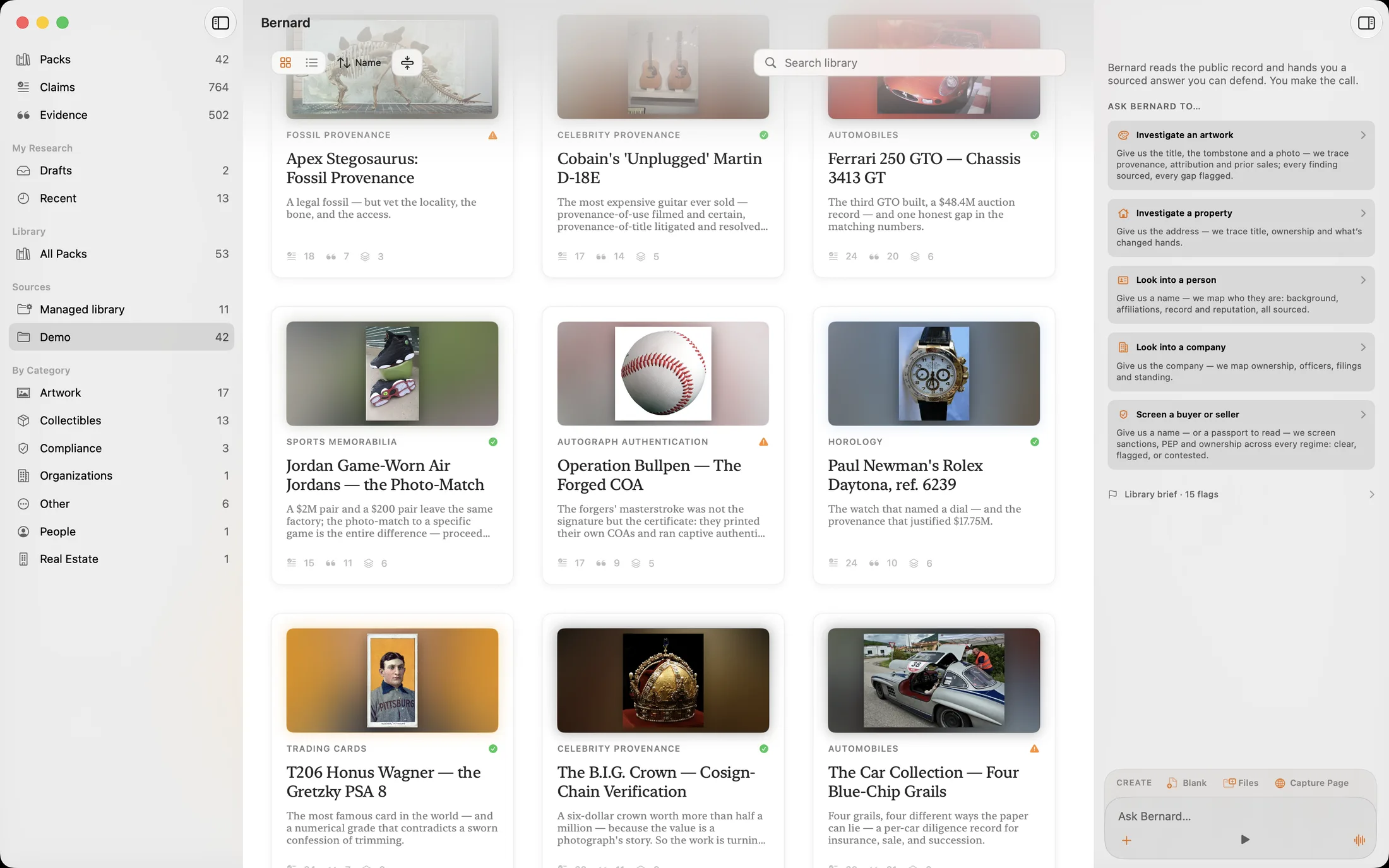
Most diligence tools only see public data. Bernard connects the private material you bring with public-record research and developing specialist coverage, every result linked to its source.
You bring · private
Bernard researches · public
Bernard is building · specialist
Private, public, and proprietary, synthesized into one source-linked record.
Why Bernard
Bernard separates retrieval breadth from evidentiary strength. Repeated mentions of the same source do not raise confidence; independent source lineage can.
Three tools finding one article is still one source. Repeated mentions of one underlying origin are treated as one source.
Filings, registries, catalogues raisonnés, and source documents anchor claims wherever they are available.
Missing primary routes remain visible as gaps, open actions, or contradictions, never smoothed over.
Local-first by design: the Knowledge Pack is the durable record you keep. Each pass works from a scoped slice and returns cited findings, not opaque summaries.
Markets
Bernard starts where mistakes are public, evidence is fragmented, and the tooling is decades behind. The research lens changes by asset class; the record stays one thing.
Provenance, condition, ownership, market context.
A source-backed provenance view, condition gaps, a comparable range, and the questions to settle before the hold expires.
Title, obligations, planning, comps, counterparty risk.
An offer-readiness view, red and amber flags, comparable support, and the next requests before the window closes.
Authority, pledge status, identity, release proof.
Proceed, pause, or ask for proof, with every material claim tied to a source.
Plain answers
Yes. KP:1 keeps the record in plain-text files, so a colleague, reviewer, or system can inspect claims, evidence, contradictions, confidence, gaps, and next actions directly.
No. Bernard is built around local-first Knowledge Packs and scoped research tasks. Evidence you upload is not used to train public AI models.
A research agent may answer a question. Bernard preserves the decision record: what was claimed, what evidence supports it, where sources disagree, what remains unproven, and what action is justified next.
Decision context, claims, evidence, contradictions, confidence, gaps, next actions, readable views, and revision history, in a portable .kpack folder.
The responsible professional. Bernard preserves evidence and open questions; it does not make or replace the decision.
See it work
Introducing Bernard.
Diligence for professionals who handle sensitive, high-stakes work.
When a good opportunity comes in, everyone wants to move. The price looks fair. The documents look complete. The buyer is ready.
This is when teams face a bad choice. Move fast and hope nothing is missing. Or slow the deal down while someone checks.
Bernard gives you a third option. It does the careful check right there, in minutes, while the opportunity is still live.
It reads the details. It checks the names. It flags what does not add up.
Here is Larkspur Study. It looks ready to consign.
But Bernard finds three problems. The signer is not the trust. The artwork is already listed on a lender schedule. And the release letter is missing.
So the next step is clear. Do not approve it yet. Ask for proof the signer can act for the trust, and proof the lender has released the artwork.
The same careful check works across the whole library.
A townhouse looks ready to exchange, until the title notice is still on the register.
A new person or company looks ready to send funds, until the passport name does not match.
A loan against artwork looks ready to fund, until an old pledge is still open.
Bernard is not there to stop the work. It shows what has to be fixed, so the work can keep moving with proof.
And sometimes, after the same checks, everything lines up.
The authority is clear. The release is in. The payment route is approved.
That is the green light. Now the answer can be yes.
Bernard does not make the final call for you. It keeps every claim tied to a source, so you can see the proof yourself.
Bernard runs locally. Your files stay on your device. Your work stays private.
You stay in charge. Bernard finds the facts, connects the sources, and gets out of the way.
Bernard. See what matters before you move.
Bernard runs the research. The expert makes the call.